Nathan Wilson
 14/07/2026
What Can Wine Investors Learn From This Sale?
A 124-bottle collection from Domaine de la Romanée-Conti has sold for €490,104, almost 44% above its lower estimate.
The headline is impressive, but the real story lies beneath it. Direct provenance, tiny production, perfect critic scores and bidding from 17 countries turned one private cellar into a global contest.
For wine investment, the sale offers a clear reminder: even when the wider Burgundy market is correcting, the rarest bottles can continue to command extraordinary demand.
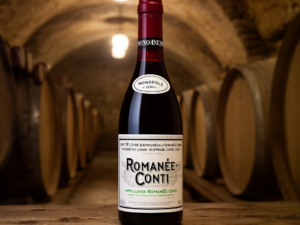
The collection belonged to a long-term French collector who had acquired the wines directly from Domaine de la Romanée-Conti, commonly known as DRC. He eventually accepted that he would never be able to drink every bottle and decided to release part of the cellar through iDealwine.
The final figures were remarkable:
The collection finished approximately 43.7% above its lower pre-sale estimate of €340,940.
This was not simply a case of one trophy bottle inflating the result. Demand extended across nine different DRC cuvées, from Échézeaux and Corton to La Tâche, Montrachet and Romanée-Conti itself.
The cellar represented an unusually broad selection of DRC wines:
| DRC wine | Bottles offered |
|---|---|
| Romanée-Conti Grand Cru | 7 |
| Corton Grand Cru | 4 |
| Montrachet Grand Cru | 2 |
| Corton-Charlemagne Grand Cru | 3 |
| La Tâche Grand Cru | 22 |
| Échézeaux Grand Cru | 25 |
| Grands-Échézeaux Grand Cru | 21 |
| Romanée-Saint-Vivant Grand Cru | 25 |
| Richebourg Grand Cru | 15 |
| Total | 124 |
The seven Romanée-Conti bottles covered the 2012, 2014, 2015, 2016, 2017, 2020 and 2022 vintages. Together, they achieved an average price of €16,893 per bottle. That breadth matters. It gave collectors access to several of the domaine’s most tightly allocated wines without requiring them to purchase a complete original assortment.
For more background on the region’s vineyards and classification system, explore Moncharm’s guide to Burgundy fine wine
The auction’s most valuable lot was a single bottle of Romanée-Conti 2015.
After 30 online bids (more than five times the auction average) it achieved a hammer price of €16,200. That was 24.6% above its €13,000 pre-sale estimate. Once commission and VAT were added, the buyer paid €20,380.
Why did this particular bottle attract so much competition?
The 2015 Romanée-Conti carries an exceptional set of ratings:
It is rare to find such agreement among the world’s leading critics. For investors, that consensus reduces uncertainty around quality and strengthens future collector demand.
The bottle also came from a highly acclaimed Burgundy vintage with considerable ageing potential. Add DRC’s global reputation and production of little more than 6,000 Romanée-Conti bottles in a typical year, and the intensity of bidding becomes easier to understand.
The €20,380 result was strong, but it did not represent a new peak.
The same wine sold for €19,247 in November 2024, meaning the latest result was approximately 5.9% higher. However, Romanée-Conti 2015 reached €31,620 in 2022. The latest sale remains around 35.5% below that high.
That comparison is important.
It shows that even the most prestigious wine investments experience pricing cycles. DRC is not immune to changes in market sentiment, liquidity or buyer confidence. Yet the latest result also suggests that serious demand remains at the corrected price. Thirty bids for a single bottle do not indicate a market without buyers. They indicate buyers who are willing to compete, but only at valuations they consider defensible.
Moncharm’s analysis of the red Burgundies dominating 2026 explores this shift towards more selective Burgundy buying.
The Romanée-Conti vineyard covers approximately 1.85 hectares. Its annual production is usually little more than 6,000 bottles, although the exact figure changes with the vintage. That is a tiny supply for a wine with worldwide recognition.
Access is also heavily controlled. Buyers typically receive Romanée-Conti as part of a mixed allocation containing other DRC cuvées. Securing a standalone bottle through normal distribution can be extremely difficult.
Once released, supply begins to contract.
Some bottles are consumed. Others disappear into private cellars. A small proportion may be damaged, lost or stored without sufficient documentation. Over time, the number of investable examples with strong provenance becomes progressively smaller.
This is the scarcity mechanism at the centre of many successful fine wine investments: fixed original production followed by declining availability.
The geographical spread of bidders was another significant feature of the sale.
Asian collectors purchased 57 lots, representing 46% of the collection by volume. Hong Kong buyers led the activity, with additional participation from South Korea and Singapore. European buyers outside France acquired 42 lots, or 34% of the sale. The successful bidders came from markets including Germany, Luxembourg, Poland, Denmark, Spain, Austria, Belgium, Italy and Switzerland.
French collectors purchased 15 lots and paid the highest average unit price at €7,707 per bottle. They also secured four of the seven Romanée-Conti bottles. American buyers acquired a further nine lots, representing approximately 7% of the auction.
Why is that geographical diversity valuable?
Because it reduces dependence on one market. A wine wanted in France, Hong Kong, Singapore, mainland Europe and the United States benefits from a much deeper potential buyer base. Global recognition supports liquidity. It gives owners more possible routes to exit and helps the finest producers remain relevant even when demand from one country slows.
Headline auction results can create a misleading impression that the entire Burgundy market is booming, the wider data tells a more measured story.
According to iDealwine’s 2026 auction barometer, the average price of wine sold through its auctions fell by 8.2% during 2025.
At the same time:
More wine changed hands, but buyers became increasingly price-conscious.
That distinction matters. The fine wine market is liquid and active, yet performance is concentrated around bottles with exceptional fundamentals. DRC occupies the very top of that hierarchy. Its results should not be projected onto every Burgundy producer or vintage.
Domaine de la Romanée-Conti remains one of the clearest examples of what can happen when quality and scarcity meet worldwide demand.
A 124-bottle collection achieved €490,104, beating its lower estimate by almost 44%. Romanée-Conti 2015 attracted 30 bids and sold for €20,380, supported by multiple perfect critic scores and annual production of little more than 6,000 bottles. Yet the sale also carried a note of caution. That same 2015 vintage remains more than 35% below its 2022 auction peak.
For investors, both facts matter.
The finest wines can retain an extraordinary ability to attract buyers, but selection, provenance and entry price remain essential. That balance between rarity and discipline is what turns a remarkable bottle into a credible investment.
 21 Jul 2026