 Matthew Knight
 16/06/2026
US Fine Wine Is Growing Rapidly
For years, the conversation around wine investment has been dominated by Bordeaux, Burgundy and, more recently, the Super Tuscans.
But something interesting is happening.
American fine wine is no longer sitting on the sidelines. It’s taking a larger share of the global market, attracting more investor attention and proving that the world’s best Californian producers deserve a place alongside the traditional fine wine heavyweights.
The latest data from Liv-ex shows that demand for US fine wine is growing rapidly, and for investors, that’s a trend worth paying attention to.

A decade ago, US wines accounted for just 1% of trade on Liv-ex.
Today, that figure stands at 8%, representing one of the most significant shifts in the modern fine wine market. Even more importantly, buyers across every major region are allocating a larger share of their spending to US wines than at any point in the last ten years.
That’s not simply a story of increased supply.
According to Liv-ex, it reflects growing confidence in the collectability and investment credentials of American fine wine. Investors are not just buying more bottles; they are spending more money on higher-value wines.
That distinction matters.
In the world of wine investment, rising values often tell a more important story than rising volumes.
When people talk about US fine wine, they are overwhelmingly talking about California.
Liv-ex data shows that Californian wines account for around 99% of all US wine trade on the platform. Other American wine regions continue to develop their reputations, but California remains the engine driving international demand.
This shouldn’t come as a surprise.
Napa Valley has spent decades building its reputation. From the famous Judgement of Paris tasting in 1976 to the rise of cult producers such as Screaming Eagle, Harlan Estate and Dominus, California has steadily earned its place among the world’s elite wine regions.
What has changed is the level of acceptance within the investment community, collectors no longer view top California wines as alternatives to Bordeaux or Burgundy.
Increasingly, they view them as peers.
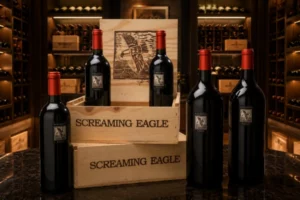
The Liv-ex report highlights two names in particular: Screaming Eagle and Opus One.
Together, these two estates account for between 25% and more than 40% of the total traded value of US wines on Liv-ex, depending on market conditions. Around a quarter of all US wine trades by frequency in 2026 have involved one of these producers.
That’s a remarkable level of concentration.
It demonstrates something we see repeatedly in the fine wine world: investors gravitate towards brands they trust.
Screaming Eagle has become one of the most exclusive and sought-after wines in the world. Production remains tiny, allocations are scarce, and global demand consistently exceeds supply.
Opus One occupies a different position. As a collaboration between the Mondavi family and Château Mouton Rothschild, it combines Californian winemaking with Bordeaux heritage. That story continues to resonate with collectors globally.
One of the most interesting findings in the Liv-ex data is the strength of the 2018 vintage.
Among US wines traded this year, the 2018s have led both value and volume, Opus One 2018 provides a particularly fascinating case study.
After falling to a low of £2,388 per 12-bottle case in March, the wine has rebounded strongly. Trade prices have risen above both its ex-negociant and ex-London release levels, reaching approximately £2,800 per case.
That recovery is significant.
When a wine begins trading above its original release price and continues to attract buying interest, it often indicates growing confidence among market participants, for investors, these are exactly the types of signals worth monitoring.
While Screaming Eagle and Opus One dominate the headlines, they are not the whole story.
Liv-ex reports that more than 140 different US wines have traded this year, demonstrating increasing depth within the category. Producers such as Harlan Estate, Promontory, Dominus, Scarecrow, Continuum, Sine Qua Non, Ridge and Joseph Phelps are all contributing to the growth of the market.
Promontory is particularly interesting.
Backed by the Harlan family, it has established itself remarkably quickly as a serious player within the fine wine market. Its rise shows that while heritage remains important, new brands can still emerge when quality and reputation align.
This growing diversity is healthy.
A broader market creates greater liquidity, attracts more collectors and ultimately strengthens the long-term outlook for the category.
For those involved in wine investment UK, the rise of US fine wine presents both an opportunity and a challenge.
The opportunity is obvious.
As demand increases globally, investors who have exposure to leading Californian producers may benefit from growing recognition and stronger secondary market activity.
The challenge lies in selectivity.
Not every Californian wine will become an investment-grade asset. Just as in Bordeaux or Burgundy, the strongest performance tends to come from producers with established reputations, limited production and proven international demand.
The market is becoming more sophisticated and buyers are increasingly focusing on quality over quantity, that’s a positive development.

 20 Oct 2026